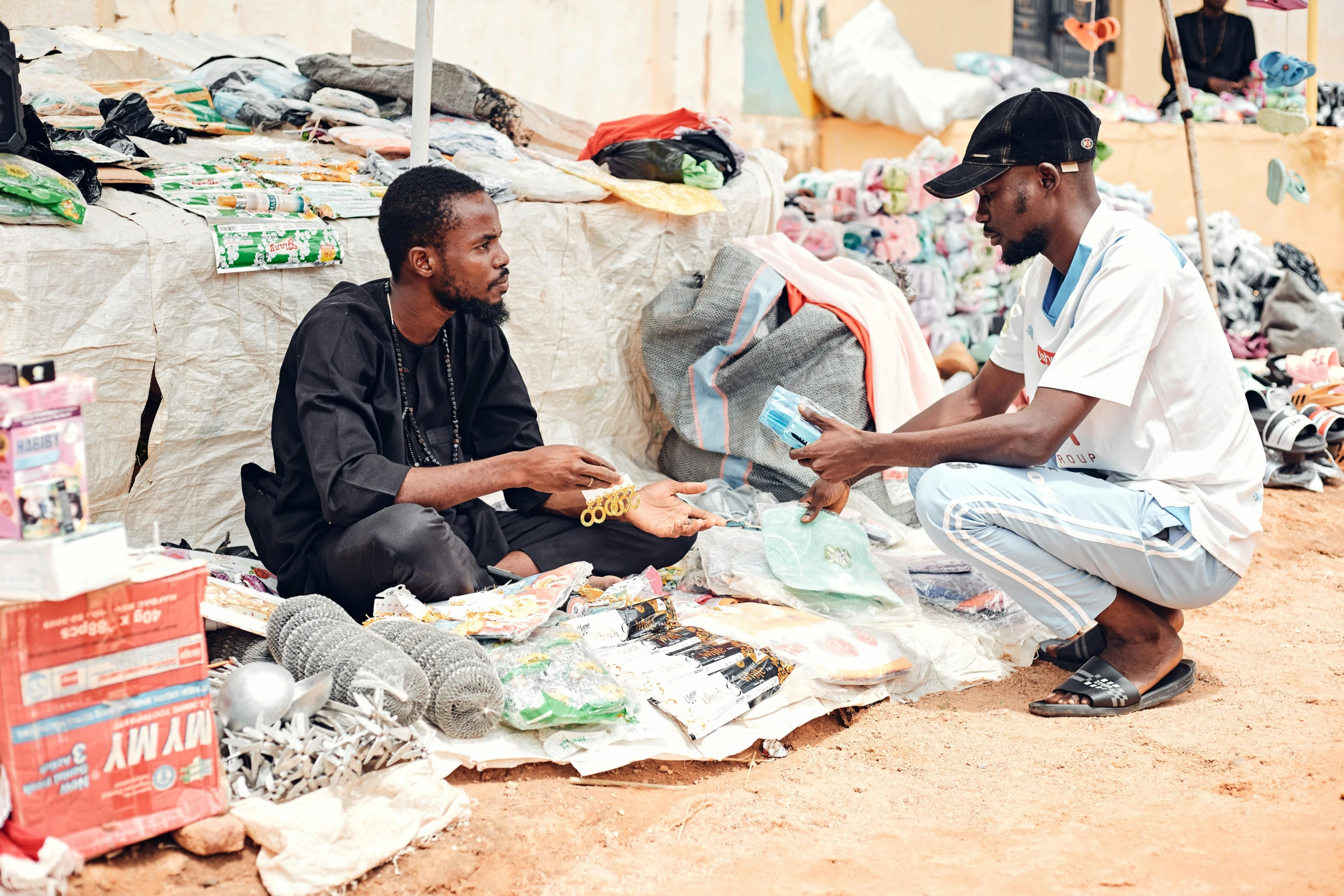

The usual customer discovery methods don’t just fail, they actively mislead you. The focus groups lie. The surveys deceive. The interviews tell you what people think you want to hear, not what they’ll actually do.And most social entrepreneurs only discover this after they’ve burned through their pilot funding.But here’s the good news: customer discovery in low-income markets isn’t impossible. It’s just different. Once you understand why traditional methods fail and what actually works, you can build products people genuinely need and will actually pay for.
Why Traditional Customer Discovery Fails in Low-Income Markets
Before we talk about what works, let’s understand why the standard playbook falls apart when you’re serving low-income customers in Africa.
Failure Reason #1: The Social Desirability Trap
In many African cultures, there’s a strong inclination to be polite, agreeable, and avoid confrontation — especially with outsiders who are “trying to help.” When you show up with a prototype and ask, “Would you buy this?” most people will say yes because:
- They don’t want to hurt your feelings.
- They want to appear progressive and interested in improvement.
- They think you might be connected to NGO aid and saying “no” could cost them.
- They’re imagining a hypothetical scenario, not making a real purchasing decision.
Safaricom learned this the hard way during early M-PESA development. Focus groups said they’d happily send money via mobile phone. But when they piloted, adoption was dismal. Why? Because in interviews, people imagined an ideal scenario. In reality, they encountered friction: agent availability, trust issues, habit change, family resistance.
The breakthrough came when Safaricom stopped asking what people would do and started observing what they actually did with money transfers — hiring matatu drivers as couriers, using bus conductors, sending cash via friends. This revealed the real jobs-to-be-done and the real barriers.
The lesson: People are terrible at predicting their own behaviour, especially in hypothetical scenarios. What they say they’ll do isn’t what they’ll actually do.
Failure Reason #2: The Income Volatility Blind Spot
Most customer discovery assumes relatively stable incomes and predictable expenses. This is catastrophically wrong for low-income markets.
A smallholder farmer in rural Kenya might tell you in March (post-harvest) that they can absolutely afford your 3,000 KES product. Come back in August (pre-harvest, after school fees), and that same farmer has zero cash available. You conclude the product is unaffordable. But it’s not — the timing is just wrong.
Daily-wage labourers, informal sector workers, and smallholder farmers often have:
- Irregular income: Money comes in unpredictable chunks.
- Competing priorities: Every shilling has five urgent uses.
- Seasonal cash flow: Massive variation across the year.
- Hidden expenses: Funerals, medical emergencies, social obligations that appear suddenly.
When you ask, “Can you afford this?” what period are they thinking about? What assumptions are they making about other expenses? You have no idea.
One Acre Fund, which provides financing for agricultural inputs to smallholder farmers, spent years figuring out optimal repayment schedules. They discovered that asking farmers when they could pay was useless. Farmers would confidently commit to schedules they couldn’t keep — not because they were lying, but because they genuinely couldn’t predict their cash flow 3-6 months out.
The solution? One Acre Fund stopped asking and started analysing: when do farmers historically have cash? Right after harvest. So repayment is structured to align with this reality, not with farmer predictions.
The lesson: Low-income customers can’t accurately predict their own financial capacity. You need to understand their actual cash flow patterns, not their stated intentions.
Failure Reason #3: The Wrong Context Problem
You’re conducting interviews in a community centre. Or in someone’s home. Or in a focus group facility in town. You’re asking people to imagine using your product in their daily life.
But you’re missing everything about the actual context of use:
- Who else influences the purchase decision (husband, mother-in-law, savings group)?
- What are the competing uses for that money that week?
- What does their home actually look like, and will your product even work there?
- What are the social dynamics that shape behaviour?
- What are the informal systems they already use?
Sanergy designed beautiful, innovative toilets for Nairobi’s informal settlements. Initial customer interviews suggested strong demand. But when they installed the first units, usage was far below projections.
Why? Because the interviews happened in artificial settings where people couldn’t visualise the actual dynamics: toilet locations created social status issues, shared courtyards meant privacy concerns, landlord-tenant relationships affected decision-making, and existing informal waste disposal systems had complex social contracts.
Sanergy only figured this out when they stopped interviewing and started immersing: living in the settlements, observing actual behaviour, understanding the full context of daily life.
The lesson: Context shapes behaviour more than preferences. You can’t discover this in an interview room.
Failure Reason #4: The Literacy and Numeracy Gap
Many traditional customer discovery methods assume customers can easily engage with surveys, rating scales, probability questions, and numerical trade-offs.
In low-income African markets:
- Literacy rates may be low.
- Numeracy skills vary widely.
- Abstract concepts like “rate this from 1-10” are culturally unfamiliar.
- Percentage-based questions confuse people.
- Written surveys exclude the very customers you need to reach.
When you ask someone to “rate their satisfaction from 1 to 10” or “estimate how much they’d pay,” you’re often getting random numbers or socially appropriate answers, not genuine insight.
BRAC in Uganda discovered this when trying to validate microcredit demand. Formal surveys produced confusing results. But when they used visual tools — showing actual banknotes, using picture cards, demonstrating products — suddenly customer preferences became crystal clear.
The lesson: Your research methods must match your customers’ communication styles and cognitive context. Western corporate research techniques often don’t translate.
What Actually Works: The Seven Principles of Low-Income Customer Discovery
Now let’s get practical. How do you actually discover what customers need, want, and will pay for?
Principle #1: Watch Behaviour, Don’t Ask About Intentions
The gold standard for customer discovery in low-income markets isn’t interviews — it’s ethnographic observation.
Spend time in customers’ actual environments. Watch what they do with money, time, and resources. Observe their workarounds, hacks, and existing solutions. Notice the jobs they’re trying to get done.
LifeSpring Hospitals in India didn’t ask poor women what they wanted in maternity care. They spent months observing: Where do women go now? What do they spend money on? What compromises do they make? What informal systems do they use?
They discovered that women wanted affordable maternity care, but they also wanted dignity, privacy, and respect — things traditional low-cost facilities didn’t provide. This observation led to a completely different business model than interviews would have suggested.
How to apply this:
- Spend at least 2-3 full days in your target customers’ environment.
- Go at different times (morning, afternoon, evening) to see varied behaviour.
- Don’t just observe — participate in daily activities where possible.
- Focus on existing coping mechanisms and workarounds.
- Map the full context: physical, social, economic
What to look for:
- What problems are they solving with makeshift solutions?
- Where are they spending money that could be redirected?
- What patterns repeat across different households?
- What social dynamics influence decisions?
- What are the friction points in their current systems?
Principle #2: Test Willingness to Pay with Real Money
Never trust stated willingness to pay. Only trust revealed willingness to pay.
The moment someone has to make an actual purchasing decision with their actual money, everything changes. Suddenly, all the competing priorities become real. The trade-offs become visible. The true price sensitivity emerges.
d.light tests every new product by selling it, not by asking if people would buy it. They run small-scale pilots where customers use real money, make real trade-offs, and face real consequences. Only products that pass this test get scaled.
How to test with real money:
- Create minimum viable products (MVPs) you can actually sell.
- Price them at your intended price point — don’t discount “for the pilot”
- Let customers make real purchasing decisions without artificial pressure.
- Offer money-back guarantees to reduce risk but track who actually returns products.
- Test different price points with different customer groups.
What you’ll learn:
- Real price sensitivity (not hypothetical).
- Actual purchase triggers.
- True barriers to adoption.
- Genuine competitive alternatives.
- Honest feedback (people are blunt when they’ve paid).
Principle #3: Use Visual and Tactile Research Methods
Replace abstract questions with concrete, visual, and hands-on research techniques.
Instead of asking “How much would you pay?” show actual money and products. Instead of “Rate this feature,” show different prototypes and watch which one they pick up first.
IDEO.org uses brilliant tactile research methods in their human-centred design work across Africa:
- Product sorting: Show multiple existing products, ask customers to arrange them by preference, importance, or any criteria.
- Money allocation: Give customers a stack of play money, show them product options, watch how they allocate.
- Prototype ranking: Create rough physical prototypes, let people handle them, observe which ones they explore most.
- Picture cards: Use images to represent concepts when verbal descriptions might confuse.
- Journey mapping with objects: Use physical items to represent steps in a process.
These methods work because they’re intuitive, engaging, and reveal preferences through action rather than verbal response.
Example technique — The Money Game:
Give participants 1,000 KES in play money. Show them 10 products/services they actually use (include your product). Ask them to “spend” their money. Watch:
- What do they prioritise?
- What do they exclude?
- How do they make trade-offs?
- What do they justify buying versus skipping?
This reveals true priorities in a way “What would you buy?” never could.
Principle #4: Embrace the ‘Mother-in-Law Test’
In many African contexts, purchasing decisions — especially for households — involve multiple stakeholders with different priorities. The person you’re interviewing might love your product, but their mother-in-law, husband, or savings group chairman has veto power.
Kickstart International, which sells irrigation pumps to smallholder farmers in Kenya and Tanzania, learned that individual farmer interviews were misleading. Farmers would express interest, but then not buy.
The discovery? Purchasing decisions for farm equipment involved:
- Spouses (who controlled different income streams).
- Extended family (who had opinions on resource allocation).
- Neighbours (whose success or failure with similar products mattered).
- Savings groups (who sometimes funded purchases collectively).
Kickstart changed their discovery process to include group discussions with farming households, couple interviews, and community demonstrations. Adoption rates improved dramatically.
How to research multi-stakeholder decisions:
- Map the decision-making unit — who influences, who decides, who pays, who uses?
- Interview or observe multiple stakeholders, not just primary users.
- Conduct joint interviews with couples or families when culturally appropriate.
- Watch for non-verbal cues when one person speaks (others agreeing? Skeptical?)
- Ask about previous household purchase decisions — how were they made?
Questions to ask:
- “Who else would you need to talk to before buying this?”
- “The last time you bought something similar, how did you decide?”
- “What would your [spouse/parent/group] say about this?”
Principle #5: Study Adoption Patterns, Not Just Initial Sales
First-time purchase tells you very little. What matters is:
- Do they actually use it?
- Do they repurchase?
- Do they recommend it to others?
- Do they upgrade or expand usage over time?
M-KOPA obsessively tracks post-purchase behaviour:
- Usage patterns (how often are systems being used?)
- Payment completion rates (are people keeping up with instalments?)
- Referral rates (are customers bringing in family and friends?)
- Upgrade rates (do customers want bigger systems?)
This data reveals far more about product-market fit than initial sales figures ever could.
A product might have strong initial sales but terrible retention — meaning you nailed the marketing but missed the actual need. Or it might have slow initial sales but amazing retention and referrals — meaning you’ve found something genuinely valuable but haven’t figured out positioning yet.
What to track post-purchase:
- Usage frequency: How often do customers actually use the product?
- Satisfaction indicators: Do they maintain it? Do they report problems? Do they seek support?
- Repurchase or retention: For consumables, do they buy again? For services, do they stay?
- Referrals: Do they tell others? (Not just “would you recommend” — actual referrals)
- Upsell receptiveness: Do they want more features, bigger sizes, or additional products?
This is where genuine product-market fit is proven, not in initial customer interviews.
Principle #6: Co-Create Solutions, Don’t Extract Insights
The best customer discovery happens when you stop treating customers as research subjects and start treating them as design partners.
Proximity Designs in Myanmar involves low-income farmers directly in product design:
- Farmers test early prototypes on their own farms.
- Design engineers work alongside farmers for weeks.
- Feedback sessions happen in fields, not offices.
- Farmers suggest modifications based on actual use.
- Products go through multiple iterations with the same farmer partners.
The result? Products that genuinely work in real conditions because they were designed in real conditions with real users.
How to co-create with customers:
- Invite customers into your design process early.
- Give them agency — let them modify prototypes, suggest features, even reject ideas.
- Test in real conditions, not controlled environments.
- Iterate multiple times with the same customers so they see their feedback implemented.
- Compensate fairly for their time and expertise (yes, they’re experts in their own lives).
What makes co-creation work:
- Respect: Treat customers as partners, not subjects.
- Iteration: Multiple rounds of feedback and refinement.
- Real conditions: Test where products will actually be used.
- Transparency: Show customers how their input shaped the product.
- Patience: This takes longer than surveys, but yields vastly better results.
The Customer Discovery Toolkit: Practical Methods That Work
Here are specific techniques you can deploy this month:
Method 1: The Day-in-the-Life Shadow
Spend 12-24 hours shadowing 5-10 target customers through their full daily routine:
- Wake up when they wake up.
- Follow them through morning routines.
- Observe work, errands, social interactions.
- Watch how they spend money throughout the day.
- Notice problems, workarounds, and existing solutions.
- End when they end their day.
Cost: Minimal (your time + modest compensation for participants).
Time: 1-2 weeks for 10 participants.
Insight value: Extremely high — reveals context you’d never discover in interviews.
Method 2: The Prototype Sale
Create the crudest possible version of your product that demonstrates value:
- Set up a pop-up sale in target communities.
- Price at your intended retail price (no discounts).
- Let people examine, question, and decide.
- Track who buys, who asks questions but doesn’t buy, who ignores it.
- Interview buyers about what convinced them.
- Interview non-buyers about what held them back.
Cost: Medium (materials for basic prototypes).
Time: 1-2 days per community, test in 3-5 communities.
Insight value: Extremely high — reveals real purchasing behaviour
Method 3: The Community Huddle
Gather 8-12 people from your target segment for a 2-hour facilitated session:
- Don’t call it a “focus group” — frame it as “help us design something for you”
- Use visual tools, prototypes, and hands-on activities.
- Include the money allocation game.
- Do journey mapping together.
- Observe group dynamics and who influences whom.
- End by asking them to commit to being pilot customers if you build what they suggested.
Cost: Low (venue, refreshments, modest participation fee).
Time: Half-day per session, run 4-6 sessions.
Insight value: Medium-high — great for understanding social dynamics and group preferences
Method 4: The Competitive Shopping Mission
Send 10 customers on shopping missions with real money:
- Give them a specific need (not your product specifically).
- Give them cash to solve that need however they choose.
- Ask them to document what they considered, chose, and why.
- Interview them afterwards about the decision process.
- Note what they actually did versus what they said they’d do.
Cost: Medium (you’re funding actual purchases).
Time: 1 week.
Insight value: High — reveals real competitive landscape and decision criteria
The Seven Deadly Mistakes of Customer Discovery in Low-Income Markets
Finally, avoid these catastrophic mistakes:
- Mistake #1: Asking “Would you buy this?” instead of watching if they do.
- Mistake #2: Conducting all research in artificial settings (offices, meeting rooms, urban centres).
- Mistake #3: Relying solely on verbal responses instead of observing actual behaviour.
- Mistake #4: Interviewing only individuals when decisions are made collectively.
- Mistake #5: Testing with donor money or free products instead of real purchasing decisions.
- Mistake #6: Stopping discovery after initial launch instead of continuously learning.
- Mistake #7: Assuming your target customer is homogeneous — they’re not.
The Truth About Customer Discovery
Here’s what seven years of working with social enterprises across East Africa has taught me about customer discovery:
The enterprises that succeed aren’t the ones with the best initial ideas. They’re the ones that genuinely understand their customers — and that understanding comes from humility, immersion, and relentless testing, not from surveys and assumptions.
Your customers don’t owe you clear, accurate answers in interviews. They’re busy surviving, managing complex lives, and dealing with priorities you can’t imagine. It’s your job to understand them — not their job to explain themselves to you.
So get out of the office. Leave the survey behind. Stop asking hypothetical questions. Instead:
- Watch what people actually do.
- Test with real money and real choices.
- Immerse yourself in customers’ actual context.
- Co-create solutions with them, not for them.
- Learn continuously, not just during “the research phase”.
This is harder than sending out surveys and it takes more time than focus groups. But it works.
And in low-income markets where every shilling matters and trust is hard-won, working is all that matters.
The One Question That Changes Everything
Before you launch, before you raise money, before you build anything at scale, answer this honestly:
“Have I actually watched my target customers make a real purchasing decision with their own money — and do I understand why they decided what they decided?”
If you can’t say yes with confidence, you’re not ready. Go back. Immerse deeper. Test with real money. Watch behaviour, not just listen to words. Your customers — and your mission — deserve nothing less than genuine understanding.
What’s your biggest customer discovery challenge right now? And what’s the one method from this post you’ll test this month?