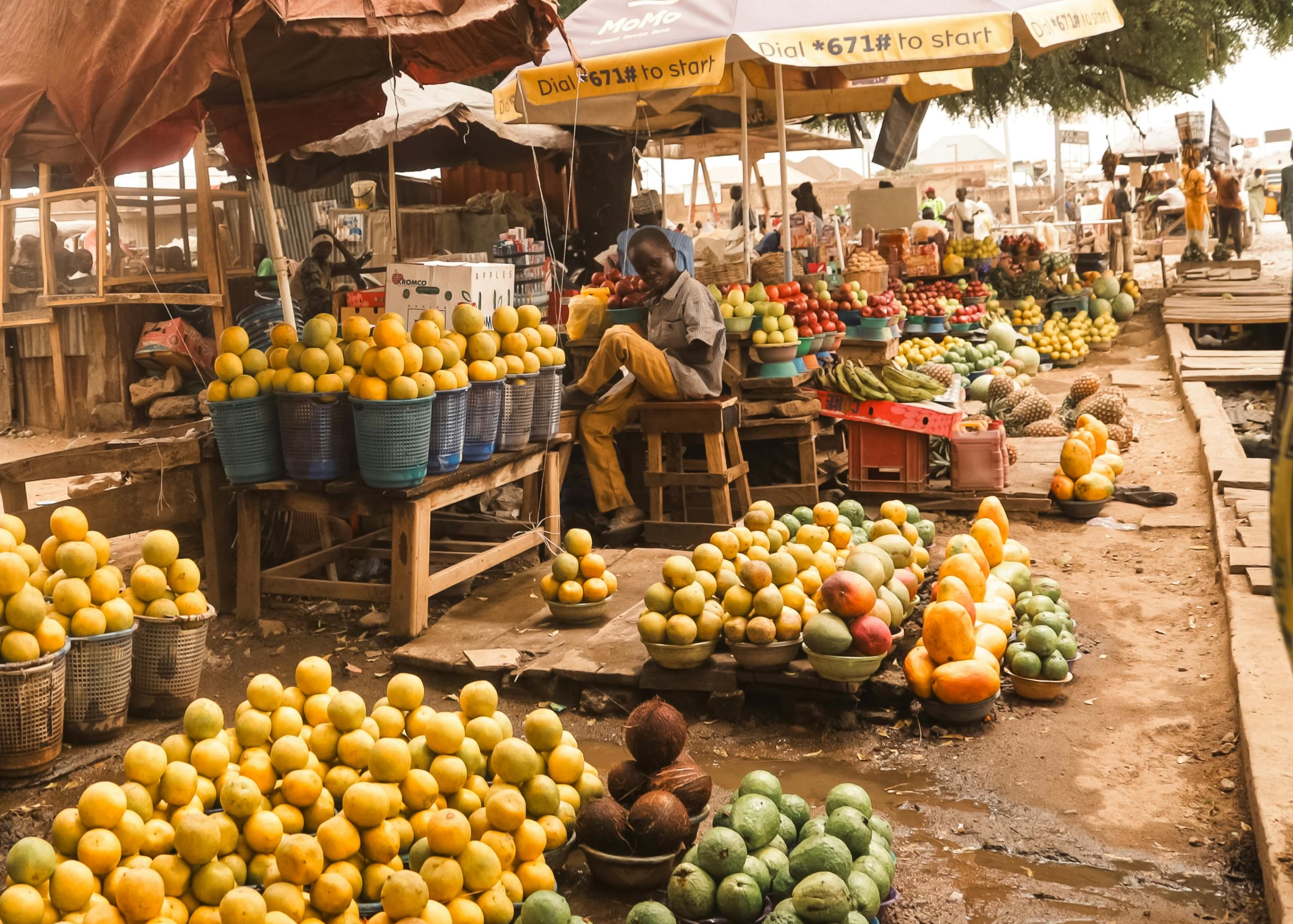
Almost everything written about Africa’s informal economy frames it as a challenge to be overcome. The most interesting social entrepreneurs on the continent have figured out it’s actually the opportunity.
Here is a number that reframes almost every conversation about African economic development: approximately 85% of employment in Sub-Saharan Africa is informal.
Not some employment. Not a significant share. Eighty-five per cent.
That means the overwhelming majority of the people your social enterprise could serve, employ, or partner with are operating outside formal economic systems — without contracts, without social protection, without access to credit, and without the supply chain relationships that formal businesses take for granted.
The standard response to this statistic is to treat it as a problem. The ILO, the World Bank, and most development frameworks spend considerable energy talking about “formalisation” — the process of bringing informal enterprises into the regulated economy. The assumption is that informal is inferior, and that the goal is to eliminate it.
But the social entrepreneurs building the continent’s most compelling businesses in 2026 have a different read. They are not trying to replace the informal economy. They are building inside it, alongside it, and in direct partnership with it — and they are generating both revenue and impact at a scale that formal-economy-only strategies cannot match.
This post is about what that looks like in practice, why it works, and what founders can learn from the ventures doing it best.
What the Informal Economy Actually Is
Before we go further, it is worth being precise about what we mean.
The informal economy is not the black market. It is not criminal activity. It is the vast universe of economic activity that happens outside formal regulation — street traders, smallholder farmers, domestic workers, artisans, motorcycle taxi operators, market vendors, homebased manufacturers, and millions of micro-enterprises that have no registered legal status, no formal employment contracts, and no access to the financial and administrative systems that formal businesses use.
In Africa, this is not a marginal phenomenon. It is the dominant reality. According to the International Labour Organisation, 60% of Africans live in rural areas where informality and climate vulnerability are the norm. In cities like Lagos, Nairobi, Dakar, and Kinshasa, informal settlements house the majority of the urban population. The informal sector generates a significant share of GDP in every African country, even where it is not captured in official statistics.
The people in this economy are not economically inactive. They are working — often extremely hard, often in multiple income streams simultaneously. What they lack is not enterprise. What they lack is access: to markets, to credit, to supply chains, to information, to services.
That access gap is where social entrepreneurs build.
Why Formal-Only Strategies Miss the Point
One of the most persistent strategic errors in African business development is designing for the formal economy and then wondering why impact is limited.
A mobile banking product that requires a national ID, a registered address, and a smartphone with reliable internet connectivity is not accessible to an informal market trader in Mombasa. A supply chain programme that requires audited financial statements excludes the 95% of smallholder farmers who have never had an accountant. A health product distributed through registered pharmacies will not reach the 70% of rural Africans who have never visited one.
This is not an argument against formal-economy engagement. It is an argument for designing around reality rather than around a hypothetical future in which everyone has been formalised.
The social enterprises that are generating the most impact in 2026 are the ones that have designed their models around the informal economy as it actually exists — not as a transitional phase to be bypassed, but as a permanent and significant feature of African economic life that deserves products, services, and supply chains designed specifically for it.
Three Ventures That Get This Right
Sanergy Collaborative (Kenya)
Sanergy is one of the most rigorously documented social enterprises on the continent. Operating in Nairobi’s informal settlements — areas like Mukuru, Mathare, and Korogocho, where public sanitation infrastructure is almost entirely absent — Sanergy has built a model that is simultaneously a public health intervention, a waste management system, and a livelihood creation programme.
The core of the model is the Fresh Life franchise: small sanitation facilities, built and operated by community entrepreneurs (Fresh Life Operators), that provide safe, affordable toilet access to residents of informal settlements. The waste collected from these facilities is then processed into high-value agricultural inputs — fertiliser and animal feed — and sold to farmers.
The numbers are striking. Sanergy delivers daily sanitation access to more than 300,000 residents, operates through more than 8,000 Fresh Life entrepreneurs, and supplies regenerative products to over 10,000 farmers. Its independently assessed social return on investment is 19 to 1 — meaning every dollar invested generates nineteen dollars of social value.
What makes Sanergy’s model relevant here is how it is built. It does not try to bring formal sanitation infrastructure to informal settlements — it builds a franchise model that works within the informal settlement’s economic logic. Fresh Life Operators are not employees. They are micro-entrepreneurs. The model generates livelihoods at the point of service delivery, and it treats the informal settlement not as a problem to be fixed but as a market with specific needs, specific logics, and specific opportunities.
Apollo Agriculture (Kenya / Zambia)
For decades, smallholder farming across Africa has been trapped between donor-backed projects, state subsidy systems, and bank lending models that considered farmers too risky, too fragmented, or too informal to finance sustainably. Apollo Agriculture is dismantling that logic — from the inside.
Apollo uses satellite imagery, machine-learning models, and mobile-based data collection to underwrite smallholder farmers without conventional collateral or formal banking histories. It delivers a customised package of high-quality inputs, crop insurance, and farming advice as a credit product — meaning farmers receive what they need at the start of the season and repay after harvest. This structure is designed around the informal economy’s actual cash flow reality: irregular, seasonal, and tied to harvest cycles rather than monthly salary schedules.
The results are measurable. Apollo farmers produce on average 2.6 times more than comparable Kenyan farmers, and 84% of customers report a better quality of life. In May 2026, Apollo completed Kenya’s first private-sector local-currency securitisation targeting smallholder agriculture — raising KES 276 million through the sale of farm-loan receivables covering 23,839 farmers, with 51% of borrowers being women and 22% first-time borrowers. The deal received an investment-grade BBB- rating from Agusto, one of Africa’s credit rating agencies.
What Apollo has done is make the informal legible to formal capital — not by formalising the farmer, but by building the data infrastructure to make their economic behaviour comprehensible to lenders and investors. The farmer’s transaction history with Apollo becomes their credit identity. The securitisation deal demonstrates that this is not just possible — it is bankable.
AACE Foods (Nigeria)
AACE Foods — Africa Alliance for Commodity Exchange — is a Nigerian food processing and distribution company that has built its entire model around the informal agricultural economy. Founded in 2009, it processes and distributes nutritious products made from West African fruits, herbs, vegetables, and cereals, sourcing its raw materials from more than 10,000 smallholder farmers across Nigeria, almost a third of whom are women.
What distinguishes AACE Foods is not just its sourcing — it is its distribution. Rather than attempting to sell through formal retail channels that don’t reach the majority of Nigerian consumers, AACE Foods operates a grassroots network of women micro-entrepreneurs called “Our Mama” who sell products door-to-door within communities. These women are not employees on fixed salaries. They are informal traders — already embedded in the trust networks of their communities — who add AACE Foods products to their existing livelihoods.
The model also explicitly supports farmers through training, access to microfinance, inputs, and storage technology. AACE Foods has demonstrated that working within the informal economy is not a compromise on quality or commercial ambition: the company was contracted by Unilever Nigeria to deliver 40 metric tonnes of turmeric, and has held discussions with Unilever South Africa and Nestlé Nigeria. Formal corporate contracts, built entirely on an informal supply chain foundation.
The AACE Foods story illustrates a principle that the best African social enterprises understand intuitively: the informal economy is not the obstacle between you and your market. In most cases, it is your market — and the women and farmers within it are not barriers to distribution, they are your distribution network.
The Five Principles Behind Informal Economy Social Enterprise
Looking across Sanergy, Apollo Agriculture, AACE Foods, and the dozens of other ventures doing this well across the continent, five principles emerge consistently.
1. Design for the customer’s reality, not the customer you wish existed.
The informal economy customer does not have a smartphone, a bank account, a formal address, or reliable electricity as a given. Every one of these is a design constraint. The ventures that succeed are those that build around these constraints — not those that assume they will disappear.
2. Make trust the infrastructure.
In formal markets, trust is built through contracts, regulation, and credit scores. In informal markets, trust is built through relationships, community reputation, and demonstrated reliability. The most successful social enterprises in informal markets invest heavily in trust-building — often slower and more expensive than a formal compliance approach, but dramatically more durable.
3. Create livelihoods at the point of delivery.
Sanergy’s Fresh Life Operators. Apollo’s network of local agents who register farmers, provide training, and facilitate access to services. AACE Foods’ “Our Mama” door-to-door micro-entrepreneurs. The most effective informal economy social enterprises do not just deliver to the community — they create economic participation within it. This is partly a values choice and partly a commercial logic: community-based delivery agents are more trusted, more persistent, and more cost-effective than external distribution networks in informal settings.
4. Use data to make the informal legible.
Apollo’s securitisation deal is the clearest recent proof of this principle: a farmer who has three years of transaction history with Apollo is more creditworthy than a farmer with no formal financial records — even if that history is entirely through an informal agricultural input programme. The data becomes the bridge between the informal economy and formal finance. Treat your customer data as a strategic asset from day one.
5. Revenue first, formalisation later.
The pressure to formalise customers, suppliers, and partners before serving them is a significant trap. Most informal-economy actors will eventually formalise elements of their operations as the economics justify it. AACE Foods built a supplier base of 10,000+ informal smallholder farmers before winning contracts with Unilever Nigeria. The social enterprises that get this right focus on creating revenue and value first, and allow formalisation to follow naturally — rather than treating it as a precondition for engagement.
What the Data Says About This Approach
The WEF’s 2026 State of Social Enterprise data makes this case with numbers. Ninety-one per cent of Africa’s social enterprises employ young people, often in informal sectors — education, agriculture, food systems, and health. Social enterprises are not peripheral to the informal economy. They are, in many respects, its most dynamic formal-sector interface.
The ILO’s 2026 priorities for East Africa make a related point: expanding social protection systems that reach workers in the informal economy, rural areas, and fragile contexts is a central mandate. Social enterprises that have already built distribution networks, trust relationships, and service delivery mechanisms in these communities are the natural partners for that expansion — not competitors to it.
This matters for how you position your venture to investors, policy-makers, and corporate buyers. The informal economy is not a gap in the market. It is the market. And the social enterprise that has figured out how to serve it well has something that formal-economy-only businesses cannot easily replicate: genuine presence, genuine trust, and genuine data in communities that nobody else has bothered to reach.
What This Means for Your Business
If you are building a social enterprise targeting African consumers, workers, or producers, the informal economy is not a risk to be managed. It is an asset to be built on.
Start with presence, not product. Before you design your product, spend time in the market. Not in the formal retail outlets or the urban business districts — in the informal markets, the smallholder plots, the roadside kiosks, and the informal settlements. The most common reason social enterprise products fail in informal markets is that they were designed by people who had never spent meaningful time there.
Partner with existing informal networks. The chama (savings group) in Kenya. The tontine in West Africa. The stokvels in South Africa. These are self-organised financial and social networks that informal-economy participants have built to manage risk and accumulate capital in the absence of formal institutions. They are not obstacles to your model — they are distribution channels, trust networks, and communities of potential franchise operators waiting to be engaged.
Price for the informal economy’s cash flow reality. Informal-economy workers do not have monthly salaries. They have daily or weekly cash flows that fluctuate significantly. A pricing model that requires a monthly payment at a fixed amount on a fixed date will fail. Daily micro-payments, pay-as-you-go structures, and flexible payment windows are not just nice-to-haves in informal markets — they are the difference between a product that sells and one that doesn’t.
Document everything you learn. The data you collect about informal-economy customers — their purchasing patterns, their seasonal income fluctuations, their supply chain relationships, their service preferences — is genuinely valuable. Not just to your business, but to the lenders, investors, and corporate buyers who have no other way to access it. Apollo’s securitisation deal demonstrates what becomes possible when that data is well-documented and consistently maintained over time. Treat your customer data as a strategic asset from day one.
The Bottom Line
Africa’s informal economy is not a transitional phase on the way to a formal economy. It is a permanent, significant, and deeply capable economic ecosystem that generates livelihoods for the majority of the continent’s population.
The social enterprises that are building the most durable and impactful models in 2026 are those that have stopped waiting for their customers to formalise and started designing for the economy their customers actually inhabit.
Sanergy did not wait for Nairobi’s informal settlements to get formal sanitation infrastructure. Apollo Agriculture did not wait for Kenya’s smallholder farmers to get bank accounts. AACE Foods did not wait for its 10,000+ smallholder farmer suppliers to register as formal agribusinesses before building a supply chain good enough for Unilever.
They built where the people were. And that is exactly where the opportunity is.
Related reading: Offline but Not Out of Reach: How to Sell to Africa’s Undigitized Markets | Building Trust in Informal Markets | Customer Discovery in Low-Income Markets