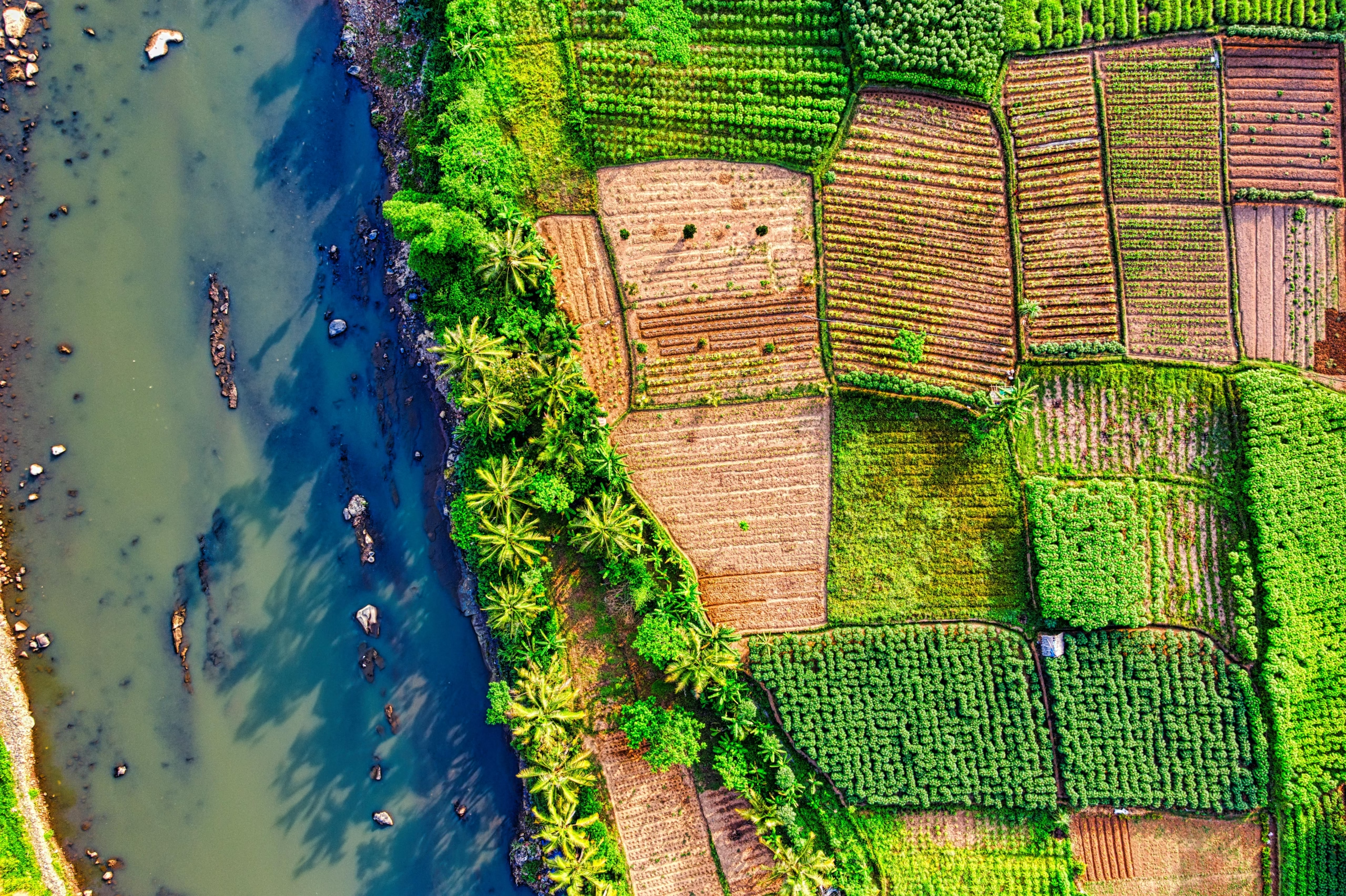
The continent that feeds a third of the world’s smallholder farmers is facing the sharpest end of climate disruption. The social enterprises building climate-smart food systems are not waiting for the crisis to stabilise. They are building the infrastructure that makes farming viable through it.
There is a number that puts the scale of the opportunity in focus: the Global Center on Adaptation is working to influence at least $10 billion in investments to build climate-smart agriculture and resilient food systems across 26 African countries — supporting food security for at least 38 million farmers and herders in the process.
That is not a projection. It is an active investment programme, supported by the African Development Bank, operating right now.
Add to that the $600 million Ethiopia Food Security Resilience Project — designed to bring digital climate-enabled solutions to 2.4 million farmers — and the $226 million Programme to Build Resilience for Food and Nutritional Security in the Horn of Africa, targeting 1.3 million farmers and pastoralists with digital advisory services and a targeted 30% increase in agricultural productivity. Then layer on the African Union’s updated CAADP 2026–2035 strategy, which sets a target of a 45% increase in agrifood output by 2035 and explicitly identifies climate-smart agriculture as the mechanism to get there.
What you have is not a niche funding stream. You have the largest coordinated capital deployment into African food systems that the continent has ever seen — landing at the exact moment when climate disruption is making conventional farming approaches increasingly unviable.
For social entrepreneurs, this is not background noise. It is the most significant market signal in African agriculture right now.
Why Climate-Smart Agriculture Is Different from Conventional AgriTech
The term “climate-smart agriculture” has been around for over a decade, and like many development sector buzzwords, it risks meaning everything and nothing simultaneously. So it is worth being precise about what it actually involves — and why it is a social enterprise opportunity rather than just a technical challenge.
Climate-smart agriculture (CSA) is built on three interconnected objectives: increasing agricultural productivity and incomes, building resilience to climate change and variability, and reducing or removing greenhouse gas emissions where possible. These objectives are not always complementary — there are real trade-offs between productivity and emissions, and between short-term resilience and long-term sustainability. Managing those trade-offs in the specific context of African smallholder farming is where the social enterprise opportunity lives.
The key insight from the most recent research — including a 2026 systematic review published in Frontiers in Sustainable Food Systems covering 60 high-quality studies — is that climate-smart agriculture interventions are most effective when implemented as integrated packages: combining drought-tolerant varieties with improved irrigation, digital advisory systems, agroecological practices, and access to finance and markets simultaneously. No single intervention works in isolation.
That finding is important for social entrepreneurs because it describes a complex, multi-component service delivery challenge that conventional commercial agriculture businesses are not well-positioned to solve. The smallholder farmer who needs drought-tolerant seeds, an affordable irrigation solution, a mobile advisory service, and access to credit and markets at the same time is not a customer that a seed company, an irrigation equipment supplier, or a digital platform can serve effectively on their own.
The social enterprise that designs an integrated package — connecting those components around the farmer rather than asking the farmer to find each component independently — is building something genuinely valuable and genuinely hard to replicate.
The Scale of What African Farmers Face
To understand why this is so urgent, the numbers on climate vulnerability in African agriculture are worth sitting with.
Sub-Saharan Africa’s smallholder farmers — who produce the majority of the food consumed on the continent — are operating in conditions of increasing unpredictability. Rainfall patterns have shifted. Droughts are more frequent and more severe. Floods follow droughts with little warning. Temperatures in key agricultural zones are rising in ways that reduce yields of staple crops. Soil degradation is accelerating in areas where intensive farming has depleted organic matter.
The $226 million Horn of Africa Food Security Programme covers a region where these pressures are acute and where the agricultural systems that millions of families depend on are under sustained stress. The Ethiopia Food Security Resilience Project’s target of a 15% reduction in food-insecure people in programme areas gives a sense of the baseline: food insecurity in these communities is not an edge case — it is the norm.
Against this backdrop, the African Union’s Comprehensive Africa Agriculture Development Programme (CAADP) has been updated for 2026–2035 with an explicit focus on climate resilience. The new strategy allocates a target of at least a portion of agricultural development funding to climate adaptation measures, and positions digital advisory services — AI-driven, satellite-assisted, mobile-delivered — as the primary mechanism for reaching smallholder farmers at scale with the climate-smart practices that increase their resilience.
Three Ventures Building Here
Hello Tractor (Nigeria, Kenya, Mozambique)
Hello Tractor was founded in 2015 by Jehiel Oliver with a deceptively simple observation: in Nigeria, smallholder farmers who hand-till their land produce 90% of the country’s crops — and the cost and inaccessibility of mechanisation is one of the most significant constraints on their productivity and climate resilience.
The company pioneered what became known as the “Uber for tractors” model: a digital platform that connects smallholder farmers who need tractor services with tractor owners who have underutilised machinery. Using IoT sensors installed on tractors, Hello Tractor tracks machine location, usage, and performance — generating data that makes the financing of agricultural equipment more viable for lenders who previously considered it too risky.
The climate-smart dimension is direct. Mechanisation reduces the time between land preparation and planting — a critical window in climate-disrupted farming where erratic rainfall means farmers who are slow to plant often miss the best conditions entirely. Tractors equipped with precision agriculture attachments also enable conservation tillage practices that reduce soil erosion and improve water retention — both significant factors in climate resilience.
Hello Tractor has expanded beyond Nigeria into Kenya and Mozambique, and its IoT and telematics technology has attracted partnerships with original equipment manufacturers and financial institutions. The pivot from tractor distribution to data-driven infrastructure — using the data generated by its tractor network to create innovative finance products — illustrates a broader pattern in climate-smart agriculture social enterprise: the most valuable asset is often not the product itself but the data and trust infrastructure built around it.
Farmerline (Ghana, operating in 14 countries)
Farmerline is a Ghanaian agritech company that uses mobile technology to deliver agricultural extension services directly to smallholder farmers. Founded in 2013, it has grown into one of Africa’s most widely deployed agricultural advisory platforms, reaching more than 2 million farmers across 14 countries.
The core service is deceptively simple: farmers receive voice messages and SMS alerts in their local language, delivering timely information on weather forecasts, planting calendars, pest and disease alerts, market prices, and best practices tailored to their specific crop and location. This last-mile extension service replaces — or more accurately, scales — the government agricultural extension officer who might visit a farming community once or twice a year, if at all.
The climate-smart relevance is significant. In a context of increasingly unpredictable weather, access to accurate, timely, locally specific climate information is one of the most effective interventions available. A farmer who receives a seven-day weather forecast that accurately predicts a dry spell can make a different planting decision than a farmer operating in the dark. Farmerline’s platform delivers this kind of decision-relevant information at scale, in local languages, to farmers who have never had reliable access to agricultural extension services.
Farmerline has also built a supply chain arm — connecting farmers to quality inputs at fair prices — and a market linkage programme that helps smallholders sell their produce to verified buyers. The platform’s 14-country footprint makes it one of the few African agritech ventures with genuine continental scale, and its local-language, mobile-first approach is designed around the reality of the farmers it serves rather than the convenience of the platform developers.
INMED South Africa
INMED South Africa’s work sits at the intersection of food security, climate adaptation, and community enterprise. Their adaptive agriculture and aquaponics programmes have benefited more than 158,000 people to date — and in early 2026, the organisation was shortlisted as a finalist for the Zayed Sustainability Prize, one of the world’s most prestigious sustainability recognitions, receiving a $100,000 prize award.
Their flagship innovation is community-scale aquaponics: closed-loop systems that combine fish farming with soilless vegetable production. Fish waste provides nutrients for crops; the plants filter and clean the water for the fish; a small pump keeps the cycle moving. The result is a system that produces both protein and vegetables year-round, using significantly less water than conventional farming, and that can be installed in a schoolyard, a community centre, or a household plot.
In the context of climate-smart agriculture, aquaponics has several critical advantages. It is largely independent of rainfall — a significant feature in regions where rainfall has become increasingly unreliable. It uses dramatically less land and water than conventional production. It generates food at the community level, reducing dependence on supply chains that can break down during climate-related disruptions. And it creates a community enterprise model: the aquaponics installation is not just a food source but a livelihood opportunity for the community members who operate it.
INMED’s Zayed Prize shortlisting in 2026 reflects growing global recognition that community-scale climate-smart food production is not just an emergency response — it is a replicable, scalable enterprise model.
The Four Market Opportunities in Climate-Smart Agriculture
Looking across Hello Tractor, Farmerline, INMED, and the broader landscape of climate-smart agri-social enterprise in Africa, four distinct market opportunities emerge for social entrepreneurs.
1. Digital advisory services. The gap between what farmers know and what they need to know — about weather, soil, pests, markets, and best practices — is enormous and largely unserved. AI-driven, satellite-assisted, mobile-first advisory platforms that deliver decision-relevant information in local languages at low or no cost to the farmer are one of the highest-leverage interventions in climate-smart agriculture. The CAADP 2026–2035 strategy explicitly prioritises this.
2. Mechanisation and precision agriculture. Owning a tractor is beyond the financial reach of 95% of African smallholder farmers. But renting one for three hours to prepare land before a critical planting window is viable — if the booking infrastructure, the pricing model, and the trust framework exist. The Hello Tractor model has demonstrated this is commercially viable. The opportunity to extend it — adding precision agriculture attachments, soil sensors, and data analytics — is significant and largely unoccupied.
3. Climate-resilient food production systems. Aquaponics, agroforestry, drought-tolerant crop varieties, conservation tillage — these are not new ideas, but packaging them into community-enterprise models that non-agricultural communities can operate is still largely uncharted territory. INMED’s aquaponics model demonstrates the template: a system that produces food, creates livelihoods, builds climate resilience, and can be replicated in any community with a small installation and basic training.
4. Supply chain and market linkage. The farmer who has adopted climate-smart practices and produced a higher-quality harvest still faces the problem of getting a fair price. Market linkage — connecting smallholders to verified buyers, premium markets, and export channels — is the revenue model that makes climate-smart agriculture economically rational for the farmer rather than just environmentally desirable. Social enterprises that can close this loop — from climate-smart practice adoption to premium market access — are building something with genuine, durable commercial logic.
What the Capital Surge Means for Social Entrepreneurs
The $10 billion in climate-smart agriculture investment that the Global Center on Adaptation is working to mobilise across 26 African countries will not flow uniformly. It will flow toward ventures and programmes that can demonstrate three things: a proven model, measurable impact, and the operational capacity to absorb and deploy capital at scale.
For social entrepreneurs building in this space, the preparation that matters most is:
Build the evidence base now. Yield improvements, water savings, income increases, food security outcomes — these are the metrics that climate-smart agriculture funders care about. If you are not measuring them systematically from the beginning, you will not have the data to capture the capital when it arrives.
Design for the integrated package. Single-intervention models — a seed company that sells drought-tolerant varieties, a platform that provides weather forecasts — are less fundable and less impactful than integrated approaches that combine multiple components around the farmer. The research is clear: integrated packages consistently outperform single interventions. Build your model to reflect this.
Position for government partnership. The CAADP 2026–2035 strategy is a government commitment. The Ethiopia and Horn of Africa programmes are government contracts. The most durable scale in climate-smart agriculture comes through national systems — not despite their slowness and complexity, but by working within them. Social enterprises that have built relationships with agricultural ministries and that can demonstrate alignment with national food security priorities are the ones that will receive the government contracts that make scale possible.
Look at the funding landscape that already exists. The Climate Finance Accelerator in South Africa, the UNCDF’s Pro-Congo programme for climate-resilient MSMEs in Central Africa, the BIRE Project for micro and small enterprises in Kenya — these are active funding mechanisms for climate-smart business models right now, with open application windows. The capital is available before the $10 billion arrives. Position yourself to capture it.
The Bottom Line
Africa’s smallholder farmers are on the front line of a climate crisis they did not create. They are also, simultaneously, at the centre of the most significant coordinated capital deployment into African agriculture in a generation.
The social enterprises that build climate-smart agriculture solutions — integrated, evidence-based, designed for the farmer’s reality rather than the investor’s preference — are not just doing important work. They are building in the most heavily funded sector in African social enterprise, at the moment when the funding is arriving.
Hello Tractor did not wait for Nigerian farming to formalise before building mechanisation infrastructure for it. Farmerline did not wait for government extension services to reach 2 million farmers before building a mobile advisory platform that did. INMED South Africa did not wait for climate disruption to stabilise before building food systems that work through it.
The farmers are waiting. The capital is moving. The question, as always, is whether the entrepreneurs are ready.
If you want to model the financial viability of a climate-smart agriculture venture — pricing, break-even, revenue scenarios — our BreakEven Pro and Pricing Wizard tools are free to download.
Related reading: How African Social Entrepreneurs Are Turning Climate Challenges into Business Opportunities | Green Finance & Climate Adaptation for SMEs | Tech-Enabled Financial Inclusion for Smallholder Farmers
Social impact. Supporting startups.