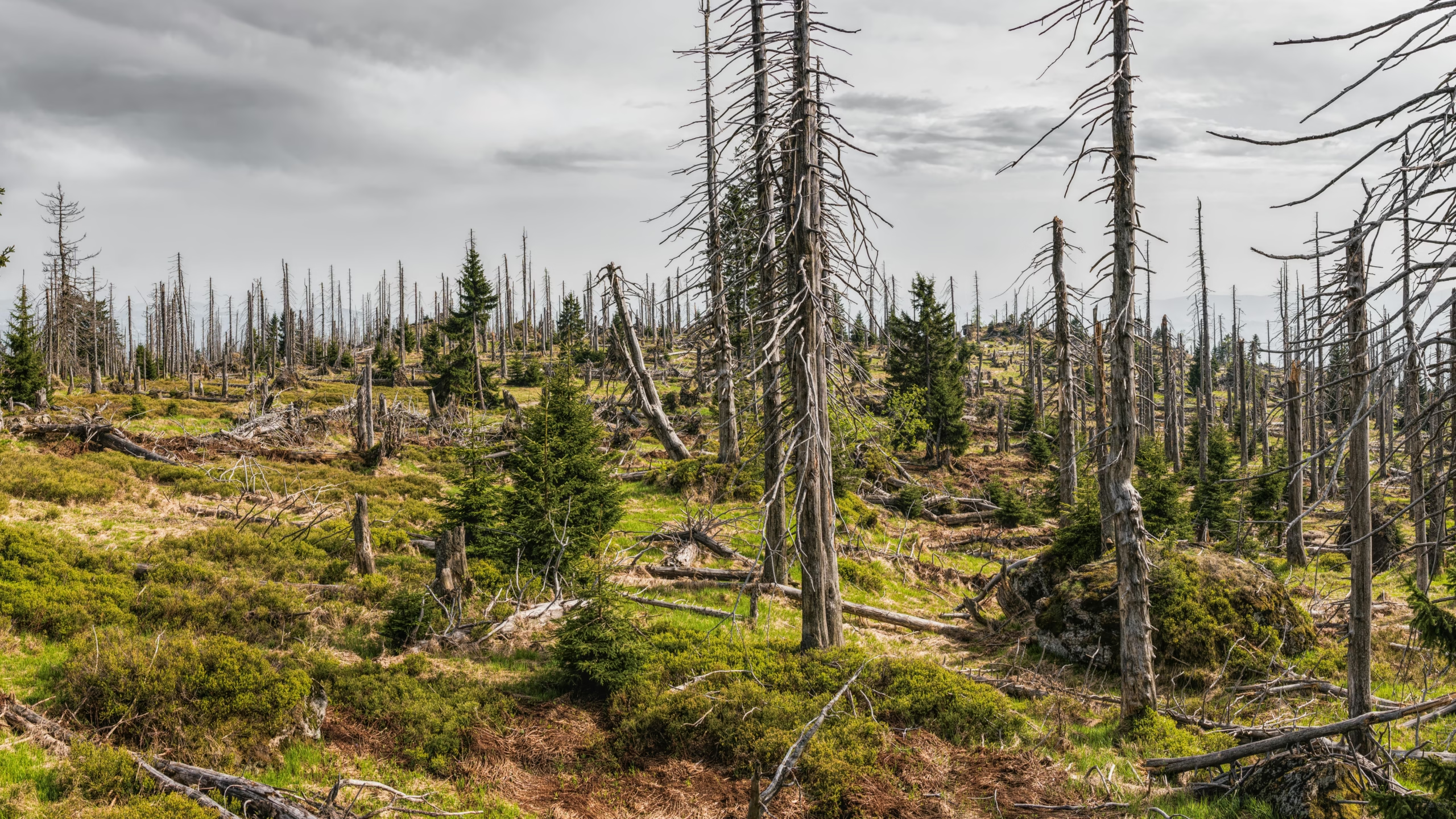
The same problems destroying livelihoods are also creating the continent’s most exciting business models.
Here’s a number that should stop you in your tracks: Africa contributes less than 4% of global greenhouse gas emissions — yet the continent absorbs more than 50% of the world’s climate-related economic losses. That’s not just unfair. It’s a market signal.
Because where there is chronic, structural damage — drought decimating harvests, plastic waste choking urban waterways, food insecurity spreading across cities — there is also an enormous, unmet demand for solutions. And across the continent, a generation of social entrepreneurs is reading that signal clearly.
They’re not waiting for governments to fix it, or for international NGOs to arrive with solutions designed elsewhere. They’re building businesses that solve climate problems and generate revenue at the same time. This post looks at what that actually looks like in practice — and what you can take from it.
The Problem With How We’ve Talked About Climate and Business
For a long time, the conversation about climate in African business circles has fallen into two unhelpful camps.
The first camp treats climate change as purely a crisis narrative — a story of loss, displacement, and existential threat that belongs in donor reports, not business plans. The second camp frames it as a Western concern, something wealthy countries invented to regulate African industrialisation.
Both positions leave money — and impact — on the table.
The truth is more practical: climate disruption is already reshaping African markets. It’s changing what crops grow where, how cities manage waste, what consumers worry about, and where investors are putting capital. According to a 2026 World Economic Forum report on African social enterprises, the continent’s most compelling growth opportunities are clustered around climate and nature — precisely because the problems are so visible and the solutions so necessary.
Social entrepreneurs who understand this are not making a sacrifice. They’re spotting a gap that conventional businesses are too slow or too risk-averse to fill.
A Framework for Thinking About Climate as a Business Opportunity
Before diving into examples, it helps to have a mental model. Climate-driven business opportunities in Africa generally fall into three categories:
1. Substitution — replacing something harmful with something better. Think bioplastics replacing conventional plastics, or solar replacing diesel generators. The product itself is the solution.
2. Inclusion — bringing marginalised people into value chains that currently exclude them, while building climate resilience in the process. Think connecting smallholder farmers to premium markets in exchange for sustainable practices.
3. Urban solutions — solving problems created by rapid, unplanned urbanisation, which both drives and is worsened by climate change. Think vertical farming, waste-to-value systems, and clean mobility.
The businesses doing the most interesting work in 2026 tend to sit at the intersection of at least two of these categories. They’re not just building a product — they’re redesigning a broken system.
Three African Businesses That Get This Right
1. Sommalife (Ghana) — Inclusion Meets Climate Resilience
Christina Gyisun founded Sommalife in northern Ghana with a deceptively simple insight: the shea tree is one of Africa’s most climate-resilient crops and one of its most valuable commodities — and yet the women who harvest it are among the continent’s poorest.
The conventional shea supply chain is extractive. Middlemen buy from smallholder women at rock-bottom prices, process the butter, and sell it at a massive premium to cosmetics multinationals. The women who do the hardest work capture almost none of the value. And because the economics are so poor, communities have been burning shea trees for firewood rather than protecting them.
Sommalife flipped this. Using a digital platform, the company connects tens of thousands of female smallholder farmers directly to higher-value markets, while also providing access to finance and climate-smart farming practices. In exchange, farmers commit to protecting and regenerating shea trees — which are critical for biodiversity and carbon sequestration in the Sahel.
The result is a business model where climate action is not a cost centre — it’s a revenue driver. Farmers earn more by protecting trees. The company earns more by selling certified, sustainably sourced shea. Buyers in Europe pay a premium for the traceability. Everyone wins, including the land.
The lesson for social entrepreneurs: look for value chains where marginalised people are doing the hard work but capturing almost none of the value. Redesign the economics, and you can unlock both income and environmental restoration.
2. Urobo Biotech (South Africa) — Substitution at the Waste End
When Urobo Biotech won the top prize at the Change The World competition in Cape Town in early 2026, their pitch was striking in its specificity. Bioplastics are increasingly common — but what happens to them at end of life? Most bioplastics end up in landfill because the processing infrastructure for them barely exists, even in wealthy countries.
Urobo’s answer is enzymatic processing: a system that breaks down bioplastic waste into high-value outputs like lactic acid, which can be sold into pharmaceutical, food, and industrial markets. Rather than treating bioplastic waste as a problem to be disposed of, Urobo treats it as a raw material.
This matters for several reasons. First, it solves a real and growing problem — the volume of bioplastic waste is increasing as brands rush to adopt it without thinking about what happens next. Second, it creates a local, high-value output that doesn’t rely on commodity pricing. Lactic acid sells at a significant premium to generic plastic waste. Third, it can be built to serve African cities first — where waste management systems are under severe pressure and plastic pollution is a visible, acute problem.
Urobo is early-stage, but their model illustrates something important: climate solutions don’t have to be upstream (generating clean energy) or even mid-stream (manufacturing sustainable products). They can be downstream — in waste, in recovery, in the circular economy. And that’s often where the least competition is.
3. Arable (South Africa) — Urban Hunger as a Climate Problem
Arable builds modular vertical farms designed for urban African markets. They placed third at the same Cape Town competition in 2026, but their model deserves more attention than a ranking suggests.
The premise is this: African cities are growing faster than their food supply chains can keep up. Fresh produce travels hundreds of kilometres to reach urban consumers, losing nutritional value along the way and generating significant transport emissions. In cities like Lagos, Nairobi, and Johannesburg, fresh vegetables are often expensive, inconsistently available, and of poor quality by the time they reach low-income neighbourhoods.
Arable’s vertical farms are designed to be modular — meaning they can be deployed in urban spaces that aren’t being used for much: rooftops, underused commercial buildings, container yards. They use a fraction of the water that conventional farming requires, no soil, and significantly less land. Because the farms are local, the produce is fresher, the supply chain is shorter, and the carbon footprint is lower.
This isn’t a theoretical model — vertical farming has been operational in parts of East and West Africa for several years, but it’s typically been positioned as a premium product for upmarket consumers. Arable’s pitch is to make it viable at scale for mainstream urban markets.
The lesson here is about proximity. Climate solutions that are also local solutions — that reduce dependence on fragile long-distance supply chains — have a natural market advantage in African cities. They solve food security, they reduce emissions, and they build resilience against supply shocks all at once.
What These Examples Have in Common
Look at Sommalife, Urobo Biotech, and Arable side by side, and a pattern emerges.
None of them is asking customers to pay more for their values. The shea butter is more traceable and better quality. The lactic acid is a premium chemical output with real industrial demand. The vegetables are fresher and more reliably available. The climate benefit is a feature of the business model, not an add-on that depends on consumer altruism.
All of them are designing around what already exists. Sommalife didn’t create a new crop — it redesigned access to an ancient one. Urobo didn’t create bioplastic waste — it created value from waste that already exists. Arable didn’t invent vertical farming — it adapted it to African urban realities.
All of them treat the ecosystem as a stakeholder. The land, the shea trees, the waste stream, the urban food system — these are not backdrops to the business. They’re part of the operating model.
Five Practical Steps If You’re Building in This Space
If you’re a social entrepreneur thinking about where climate fits into your business model, here are five questions to start with:
1. What’s breaking in your market because of climate? Don’t start with a technology or a concept. Start with what’s visibly failing — harvests, water, food supply, waste management — and work backwards to the opportunity.
2. Who is absorbing the cost of that failure? In most cases, it’s smallholder farmers, urban poor communities, or informal workers. That’s where the market gap is. That’s also where your business model can generate the most impact per naira, shilling, or cedi spent.
3. Can you make the sustainable option the economically rational one? If your model only works when customers choose to pay more for ethics, it’s fragile. If your model makes the sustainable option cheaper, faster, or better quality — that’s durable.
4. What existing value chain can you redesign rather than replace? Building from scratch is expensive and slow. Redesigning a value chain — like Sommalife did with shea — is often faster, more capital-efficient, and more likely to achieve scale.
5. Where is the waste? Waste — in food systems, in manufacturing, in energy — is often where the most overlooked opportunities sit. Urobo’s entire model is built on something everybody else was treating as a problem to be managed.
The Bigger Picture
The World Economic Forum’s 2026 data on African social enterprises describes something significant: social enterprises are no longer peripheral players in African economies. Globally, social enterprises generate around $2 trillion in revenue annually and create close to 200 million jobs. Africa’s share of that story is growing — and climate is increasingly where the most ambitious models are being built.
This isn’t charity dressed up as business. It’s business that takes the real economics of the African environment seriously.
The entrepreneurs who thrive in this space over the next decade will be the ones who understand that climate disruption is not just a risk to be managed — it’s a set of market failures waiting to be solved.
The Bottom Line
Africa’s climate challenges are real, costly, and intensifying. But they are also, increasingly, Africa’s biggest business opportunity. The entrepreneurs building in this space — Sommalife in Ghana’s shea belt, Urobo Biotech in South Africa’s waste stream, Arable in its cities — are not sacrificing profit for planet. They’re discovering that in a continent where the problems are visible and the solutions are scarce, there has never been a better time to build something that works for both.
If you’re trying to figure out how your own venture fits into this picture — or how to price and position a product that carries both economic and environmental value — our Pricing Wizard tool can help you model the numbers. Download it free at sejunction.com.
Related reading: Women Driving Africa’s AgriTech Revolution | Why Your Startup Needs Customer Development
Social impact. Supporting startups.