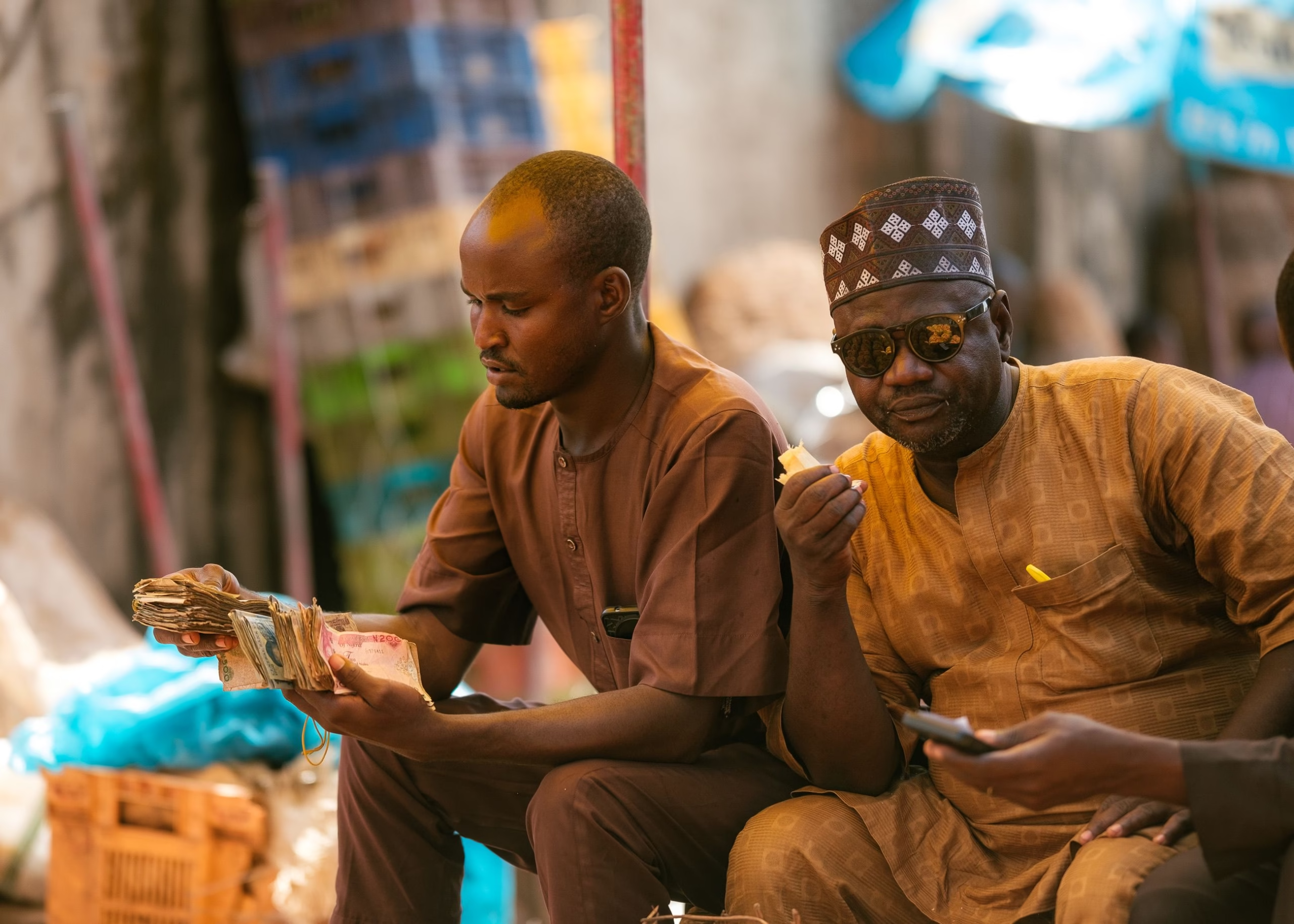

Africa’s mobile money story is genuinely remarkable. But a landmark 2026 analysis argues that what Africa has achieved is access — not resilience. The distinction matters enormously for social entrepreneurs building the next generation of financial inclusion solutions.
Here is the standard version of Africa’s financial inclusion story. Over the last fifteen years, mobile money has transformed the continent’s financial landscape. M-Pesa in Kenya, MTN Mobile Money across West and Central Africa, Airtel Money from east to west — these platforms have brought hundreds of millions of Africans into some form of formal financial participation for the first time. Sub-Saharan Africa has more mobile money accounts than any other region in the world. The transformation is real, it is significant, and it has generated enormous economic value.
Here is what the standard story leaves out.
In April 2026, a detailed analysis by Awoyinfasegun in Included VC’s publication framed the challenge precisely: “Inclusion, as currently measured, often reflects access rather than resilience.” East Africa shows high transaction-level inclusion — people can send money, receive money, pay bills — but limited depth in credit and insurance. West Africa has a vibrant fintech ecosystem but persistent credit gaps for the micro, small, and medium enterprises that drive the majority of economic activity. Women-led and rural enterprises are consistently underserved, even where digital access exists.
The distinction between access and resilience is not semantic. A person who can receive a mobile money transfer is financially included by the standard measure. A person who can access credit when her harvest fails, insure against the loss of her livestock, save safely across a lean season, and borrow for a productive investment — that person has financial resilience. The gap between those two states is where hundreds of millions of Africans are still sitting, and where the most interesting social enterprise innovation in African financial services is now happening.
Why Access Is Not Enough
The mobile money revolution solved a specific problem: transaction access for the unbanked. It solved it brilliantly. The ability to send, receive, and store money on a mobile phone without a bank account has transformed the economics of rural life, remittance receipt, and informal market trading across the continent.
But the products that create genuine financial resilience — credit, insurance, savings, and productive investment — require something that mobile money platforms alone cannot provide: a credible basis for assessing financial risk.
Credit requires a credit history. Insurance requires a risk profile. Both require data — evidence of financial behaviour, income stability, asset ownership, or repayment performance — that the formal financial system has historically not been able to collect from low-income, informal-sector customers.
This is why women-led businesses and informal enterprises remain among the most consistently underserved groups across African financial systems. Even where mobile wallet ownership among women has increased, access to credit, insurance, and productive financial tools lags significantly. World Bank Global Findex data indicate that in several Sub-Saharan African markets, women are 7–10 percentage points less likely than men to access formal financial services, and significantly less likely to obtain formal credit.
The credit gap is not primarily a technology problem. It is a data problem. And it is a structural problem: financial products designed for formal-sector employment — requiring regular income, formal identification, and collateral — systematically exclude the populations whose economic lives do not conform to that pattern.
The social enterprises building the second layer of African financial inclusion are tackling exactly this. They are finding ways to generate the data that makes risk assessment possible for customers who were previously invisible to lenders and insurers — and building the financial products that data enables.
The Three Models That Are Working
Model 1: Productive Asset Finance as a Bancarisation Channel
One of the most significant insights in recent African financial inclusion practice is that the best entry point to formal financial services for many excluded customers is not a bank account — it is an asset.
M-KOPA, the East African pay-as-you-go solar energy company, has demonstrated this model at extraordinary scale. M-KOPA’s customers pay for solar home systems through daily micro-payments on their mobile phone. These payments are small enough to fit within the irregular cash flows of low-income households. They generate power immediately — so the customer has an incentive to pay on time. And they generate, over time, a payment record.
That payment record is credit data. A customer who has made consistent daily mobile payments for a solar system over twelve months has demonstrated the kind of reliable payment behaviour that credit scoring systems value — even though none of those payments went through a bank, and even though the customer has no formal credit history in any conventional sense.
M-KOPA now uses this payment data as the basis for extending subsequent credit to customers who have completed their initial asset payments — for additional solar products, smartphones, and other productive assets. As June 2026 reporting from South Africa notes, “the pay-as-you-go model applied to distributed solar has proven to be a remarkably effective bancarisation channel. Customers pay weekly instalments via mobile, build a credit history, and in many cases that initial relationship with an energy fintech becomes their entry point to savings products, insurance and eventually formal credit.”
The M-KOPA model is instructive because it creates financial inclusion as a by-product of an entirely separate social enterprise mission — providing affordable clean energy to low-income households. The credit data is generated by the energy transaction, not by a financial transaction. This is the pattern that the most innovative models in African financial inclusion are following: building the data infrastructure for financial services through the delivery of products and services that have immediate, visible value to the customer.
Model 2: Sector-Specific Data for Credit Scoring
The second model uses sector-specific data — agricultural production data, utility payment data, supply chain transaction data — to build risk profiles for customers who have no formal credit history but whose economic behaviour is actually highly legible if you know where to look.
In South Africa, agritech companies such as Aerobotics and Khula Enterprise Finance are building agricultural risk profiles from satellite crop data, historical yield records, and prior payment behaviour. That sector-specific scoring feeds into microfinance platforms to offer seasonal financing to smallholder farmers who would otherwise be turned away by any standard credit product.
The satellite data tells a lender something that no bank statement can: whether the crops are growing, what the predicted yield is, and whether the farm’s performance this season is consistent with its historical pattern. This is a risk assessment tool specifically designed for customers whose risk profile is agricultural, not financial — and it makes credit accessible to farmers who are economically productive and creditworthy in practice, but invisible to conventional credit assessment frameworks.
The Khula-Aerobotics partnership is one of several models emerging in 2026 that demonstrate a crucial principle: you do not need to reform the entire financial system to extend credit to excluded populations. You need the right data infrastructure, built in the sectors where those populations already have a productive economic footprint, and the right financial product designed around the specific risk and cash flow patterns of that sector.
Model 3: Multi-Sector Alliance Infrastructure
The third model is more structural — and perhaps the most significant for the long-term trajectory of African financial inclusion.
The pattern gaining ground in 2026 brings together mobile operators, agritech platforms, rural cooperatives, public agencies, and specialised lenders into a shared services layer. The logic is simple: no single actor has all the data, all the trust, and all the distribution needed to serve a rural community.
This is a different kind of financial inclusion architecture from anything that has come before it. It is not a bank extending its reach through digital channels. It is not a fintech building a new product and hoping it reaches excluded populations. It is a deliberate coalition of actors — each bringing a piece of the puzzle — building shared infrastructure that none of them could build alone.
A mobile operator brings the payment rails and the customer relationship. A rural cooperative brings the community trust and the aggregation of smallholder members. An agritech platform brings the production data and the agronomic advisory. A specialised lender brings the credit product. A public agency brings the regulatory licence and sometimes the first-loss guarantee that de-risks the commercial components.
The social enterprise in this model is not necessarily any one of these actors. It is frequently the integrator — the organisation that understands how to bring these actors together, align their interests, and design the product architecture that makes the coalition work. This is a different kind of social enterprise than the ones most often profiled, but it may be the kind most needed for the second generation of African financial inclusion.
The Gap That Is Still Open: Insurance
If credit is the first frontier of the access-to-resilience transition, insurance is the second — and it is significantly less advanced.
The logic for micro-insurance in African markets is compelling. Smallholder farmers face weather, pest, and market price risk that regularly wipes out their income in a single season. Informal traders face fire, theft, and health shocks that eliminate the capital they have accumulated. Low-income households face medical costs that, in the absence of insurance, require distressed asset sales or debt spirals to manage.
The challenge is distribution and pricing. Conventional insurance products are designed for formal-sector workers with regular salaries and stable risk profiles. Micro-insurance products designed for low-income, irregular-income customers require different actuarial approaches, different distribution channels, and different premium collection mechanisms.
The emerging models that are showing most promise in 2026 are those that embed insurance into existing transactions — agricultural insurance embedded in input credit products, health insurance embedded in mobile payment plans, asset insurance embedded in pay-as-you-go purchase agreements. The most interesting fintech story in Africa right now is not in the venture-funded app studios but in the alliances between mobile operators, rural cooperatives, agritech platforms and public agencies building financial infrastructure from the ground up.
Index insurance — which pays out based on objective, independently observable conditions (rainfall, temperature, crop yield indices) rather than individual loss assessments — is particularly promising for smallholder farmers, because it eliminates the expensive individual claim assessment process that makes conventional agricultural insurance unviable at small scale. Several African markets are piloting or scaling index-based crop insurance in 2026, with mixed results — the basis risk challenge (the index may not accurately reflect individual loss) remains a significant design problem, but one that better satellite and IoT data is progressively solving.
What the Access-to-Resilience Gap Means for Social Entrepreneurs
The distinction between access and resilience creates a specific design challenge for social entrepreneurs building in financial services — and a specific opportunity.
Design for resilience, not just access. A financial product that gives customers access to a mobile wallet has achieved something real but limited. A product that helps customers save, borrow, and insure in ways that meaningfully improve their resilience to shocks has achieved something transformational. The design question is not “can our customer access this?” but “does using this make our customer more financially resilient?” These are different questions, and they lead to different product designs.
Use the data you are already generating. If your social enterprise is delivering agricultural inputs on credit, you are generating repayment data. If you are selling solar systems on pay-as-you-go, you are generating payment history. If you are running a digital supply chain platform, you are generating transaction records. This data has financial value beyond its operational purpose — it is the raw material for credit scoring, insurance underwriting, and financial product personalisation for customers who are currently invisible to formal financial systems. Think about how to make that data available, responsibly, to financial service providers who can use it to serve your customers better.
Build the coalition before you build the product. FinTech startups face a structural constraint triangle: capital, compliance, and institutional capacity. Many promising startups plateau due to interacting constraints in these three areas. The ventures that are breaking through this constraint triangle are not those that have solved all three problems alone — they are those that have built coalitions where each problem is solved by a different partner. If your social enterprise has the community trust and the customer relationships but not the regulatory licence or the credit capital, find the partners who have those components — and build the coalition before you build the product.
Focus on the intersection of financial services and your primary product. The most successful models of financial inclusion for excluded populations are those where the financial product is embedded in something the customer already values and already uses — energy, agricultural inputs, health services, supply chain. The financial product rides on the back of the trust and the relationship that the primary product has built. Social enterprises that are already serving excluded populations with non-financial products are sitting on the infrastructure for financial inclusion — if they design for it deliberately.
The Data Problem That Still Needs Solving
Despite significant progress, a fundamental data challenge remains at the centre of the access-to-resilience gap.
Inclusion gains differ markedly across Africa. Financial inclusion remains shallow and uneven across regions and demographics, with women-led and rural enterprises consistently underserved even where digital access exists.
The depth of financial inclusion — the availability of credit, insurance, and savings products — is constrained by the availability of data that makes risk assessment possible. Mobile money transactions generate some data. Agritech platforms generate sector-specific data. Pay-as-you-go asset finance generates payment history. But these data sources are fragmented, siloed, and often inaccessible to the financial institutions that could use them to extend credit and insurance to excluded populations.
The infrastructure for data sharing — data standards, consent frameworks, interoperability protocols — is still being built. Several African central banks are developing open banking frameworks that would allow customers to consent to sharing their financial data across institutions. The AfCFTA Digital Trade Protocol’s provisions on data governance create a regional framework within which data infrastructure can develop. These are the building blocks of a more connected financial data ecosystem.
For social entrepreneurs, the practical implication is to be deliberate about data governance from the start — not just as a compliance requirement, but as a strategic asset. A social enterprise that has built a clean, consented, well-documented dataset about its customers’ financial behaviour is sitting on something that financial institutions will increasingly want to access. How you govern, protect, and eventually commercialise that data is one of the most important strategic decisions in financial inclusion social enterprise.
The Bottom Line
Africa’s mobile money revolution has been genuinely transformational. It has brought hundreds of millions of people into formal financial participation and created economic infrastructure that was previously absent.
But access is not resilience. The farmer who can receive a mobile payment cannot necessarily borrow when her crops fail. The trader who has a mobile wallet cannot necessarily insure against the theft that wipes out her stock. The woman who has increased her mobile usage cannot necessarily obtain the credit she needs to grow her business.
The second generation of African financial inclusion is being built by the social enterprises and alliances that understand this distinction — that are using productive asset finance, sector-specific data, and multi-partner coalition infrastructure to build the credit, insurance, and savings access that turns financial participation into financial resilience.
M-KOPA’s customers building credit histories through solar payments. Aerobotics and Khula turning satellite crop data into agricultural credit. Multi-sector alliances in South Africa building financial infrastructure that no single actor could construct.
These are not marginal innovations. They are the architecture of Africa’s next financial inclusion chapter — and they are being built right now.
Related reading: Tech-Enabled Financial Inclusion for Smallholder Farmers | How African Social Entrepreneurs Are Turning Climate Challenges into Business Opportunities | The AfCFTA Digital Trade Protocol Is Live
Social impact. Supporting startups.